From Beyoncé's skeletal couture to Bad Bunny's aged Don Corleone interpretation, here's how the year's biggest fashion night turned celebrities into living art.
The first Monday in May arrived with its annual question (what will the celebrities wear?), and this year, the Met Gala raised the stakes by making the question literal. The 2026 dress code, "Fashion Is Art," drew from the Costume Institute's spring exhibition Costume Art, which opens to the public May 10 and runs through January 10 as the inaugural show in the Met's nearly 12,000-square-foot Condé M. Nast Galleries, a $50 million expansion built specifically to house fashion as art history. Curator-in-charge Andrew Bolton organized the nearly 400-object show by body types rather than chronology, with sections including "the Naked Body," "the Classical Body," "the Pregnant Body," and "the Aging Body," and introduced 25 new mannequins modeled on diverse, real bodies, departing from the standard size-2 form. The framing turned the exhibit into a study of how fashion shapes, conceals, and remakes the human form throughout art history.
The carpet itself wasn't without controversy. With Jeff Bezos and Lauren Sánchez Bezos serving as honorary chairs and lead sponsors, anti-billionaire group Everyone Hates Elon papered Manhattan with "Boycott the Bezos Met Gala" posters in the weeks leading up, and a counter-event called the "Ball Without Billionaires" ran in the Meatpacking District the same night. NYC Mayor Zohran Mamdani skipped the gala to focus on affordability issues, and Met Gala regulars Zendaya and Meryl Streep reportedly declined invitations over the sponsorship. The protest even climbed the Met's steps: Sarah Paulson arrived in a gray Marc Jacobs tulle ballgown with a single US dollar bill stretched across her eyes like a Magritte blindfold—a quiet, photographable dig that did the thing the dress code asked everyone to do. She wore the discourse.
But for hundreds of guests, the question was simpler: how do you turn a body into a museum object? Co-chairs Beyoncé, Nicole Kidman, and Venus Williams (alongside Anna Wintour) set the tone, and the answers came in three broad shapes: gowns that referenced specific paintings and movements; gowns that interrogated the body itself; and tailoring that pushed past the standard tuxedo into actual conceptual art. Using Mavira's style analyzer, we broke down the night's most striking looks and what they signal about where fashion is headed in 2026.
Stepping Into the Painting
The most direct interpretation of the dress code was also the most varied: dressing to look like a work of art. Anna Wintour, hosting her own show, opened the carpet in a mint-aqua ostrich-feather opera jacket cropped over a fish-scale ombré gown that faded to black at the hem. Pure transformative teal. It was a fitting overture for a night where many guests answered the brief by stepping inside a frame.
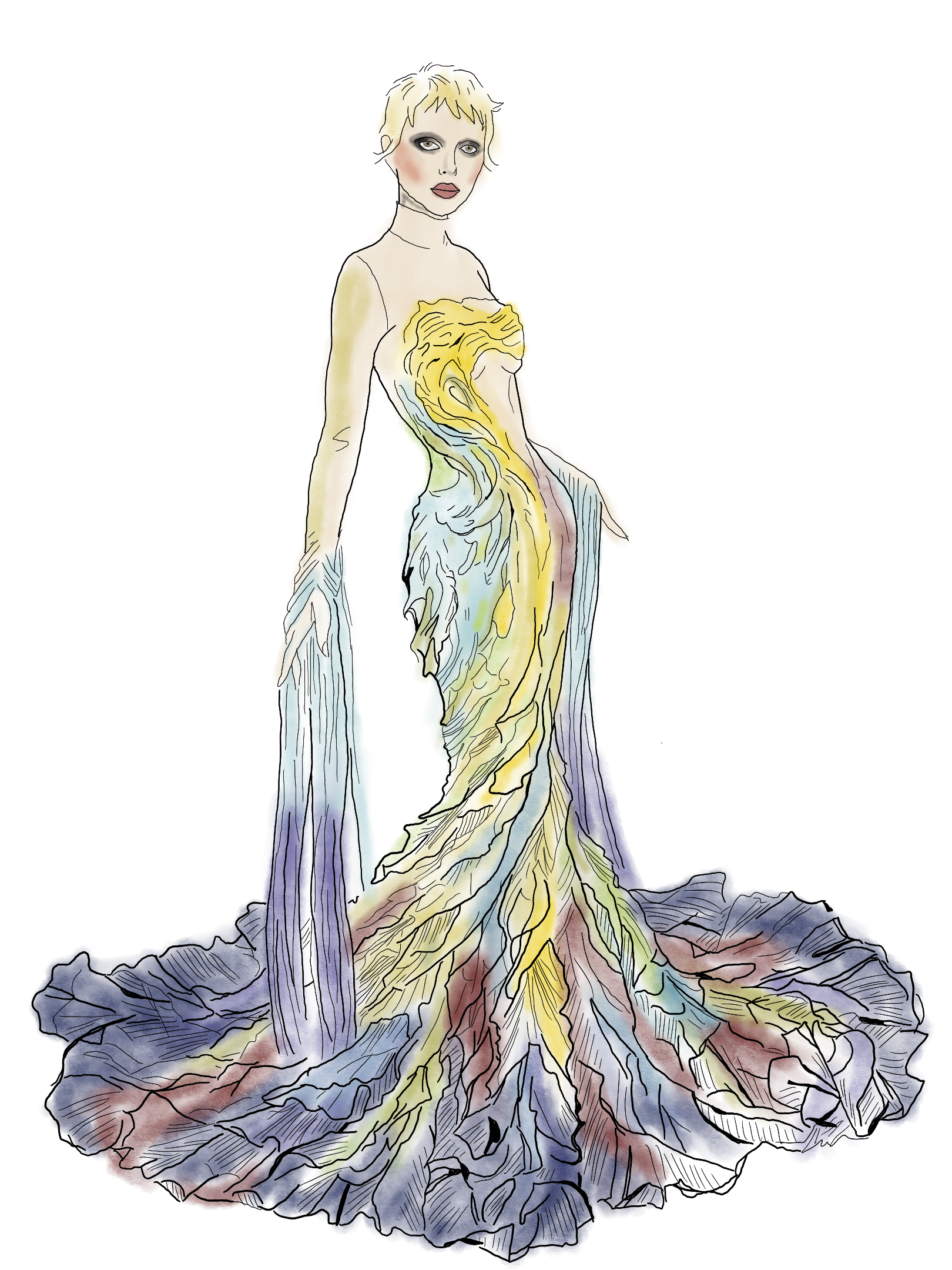
The largest single trend the analyzer flagged across women's looks was Impressionism, and Emma Chamberlain, returning for her sixth year as Vogue's red-carpet correspondent, delivered the night's most literal version in a custom Mugler gown by Miguel Castro Freitas. Her body-conforming column was a wearable Van Gogh: thick impasto brushstrokes of cadmium yellow, cobalt blue, and viridian green hand-painted directly onto the bodice and skirt, with sheer mesh extending up to a high neckline so the painting read as if applied to the bare skin. The hem pooled into a swirling chiffon ruffle storm in deep blues and purples, reading almost exactly like Starry Night, while pale ombré thread fringe trailed from her gloves. Blake Lively echoed the painterly palette in a pastel ombré chiffon ballgown with a silver-beaded halter bodice (Monet's water lilies in dress form), while Hunter Schafer went Pre-Raphaelite in a deliberately distressed white milkmaid gown with rose appliqués and torn floral chiffon revealed underneath, and Sunday Rose Kidman, Lily-Rose Depp, and Maya Hawke brought softer painterly references throughout the night. Sarah Paulson's dollar-bill blindfold, beyond the political read, was also a textbook Magritte tribute. Surrealism on the steps.
Several women went further back in art history, straight to antiquity. Heidi Klum committed completely, arriving as a literal Greek marble statue in a custom Mike Marino look (the Oscar-nominated prosthetics designer behind her annual Halloween transformations) directly inspired by Raffaele Monti's 1847 sculpture The Veiled Vestal. Her face, hands, and feet were painted in marble veining, draped in marble-textured robes with cascading folds and crowned with small white blossoms. The look was Neoclassic and Hellenic at once: a museum specimen come to life. Kris Jenner quietly delivered the gala's most literal "Costume Art" moment in a long sleeveless robe paneled with white embroidered scenes that looked exactly like classical Greek vase paintings, with figures, urns, and scrollwork rendered in bullion thread on copper sequins. Hailey Bieber continued the antiquity thread with a hammered-gold metallic Roman cuirass over a cobalt chiffon column gown with a matching shoulder cape, and Elizabeth Debicki worked the Hellenic angle in a softer key. Reaching toward Byzantium, Isha Ambani wore an architectural gold organza halo behind a shimmering champagne sari in custom Gaurav Gupta with hand-embroidered zardozi work and a layered emerald necklace, and Sudha Reddy paired a navy velvet Manish Malhotra gown embroidered with Mughal-miniature florals with a sweeping cape covered in multicolored embroidery, both gowns reading like pages from an illuminated manuscript. A'ja Wilson brought the Egyptian goddess silhouette in a column of gold lamé with cape sleeves trailing into a train.
Other looks pulled from Old Hollywood and the painterly Romantic tradition. Margot Robbie delivered restrained 1930s screen-siren glamour in a champagne metallic bias-cut column with a feathered train, anchoring a hollywood regency cluster that ran through Charli XCX in Saint Laurent by Anthony Vaccarello, Emily Blunt in Mikimoto, La La Anthony in Wiederhoeft, Charlotte Tilbury, and Nicole Kidman herself in a sequined crimson Chanel column with red ostrich feather cuffs. Anna Weyant in Marc Jacobs led the English Tea Party wave alongside Tschabalala Self, Naomi Osaka in custom Robert Wun, Laufey in a fully-sequined cream Tory Burch capelet gown, and Amanda Seyfried in custom Prada. The Bridgerton-coded romance of Lady of the Lake silhouettes (soft, devotional, almost Pre-Raphaelite) landed on Georgina Rodríguez in pale blue duchess satin with a lace and pearl corset, dangling silver rosary, and sheer blue veil; on Daisy Edgar-Jones in a feathered V-neck Alexander McQueen bridal moment; and on Dree Hemingway in Valentino, Lila Moss, Lux Pascal, and Joey King in Miu Miu.
And then there were the gowns that turned the body into a Botticelli. Imaan Hammam stunned in vermilion silk taffeta layered into five descending tiers from waist to floor, paired with massive puffed bishop sleeves and a jet-black gemstone collar. Pure flamenco by way of Goya. SZA arrived with a crown of live yellow orchids and chrysanthemums shooting upward over a marigold corseted ballgown with painted peonies and sheer organza overlay, beaded face chains, and henna across her hands: a Botticelli Primavera by way of Frida Kahlo. Tate McRae rendered the wheat-goddess silhouette in gold lace with a feathered leaf neckline, Doechii went full Mesopotamian deity in a wine-chiffon goddess gown with a towering oxblood velvet turban and gold anklets, and Tyla brought modern Cleopatra energy in a chandelier-beaded mesh top and turquoise satin wrap skirt.
The Body as Canvas
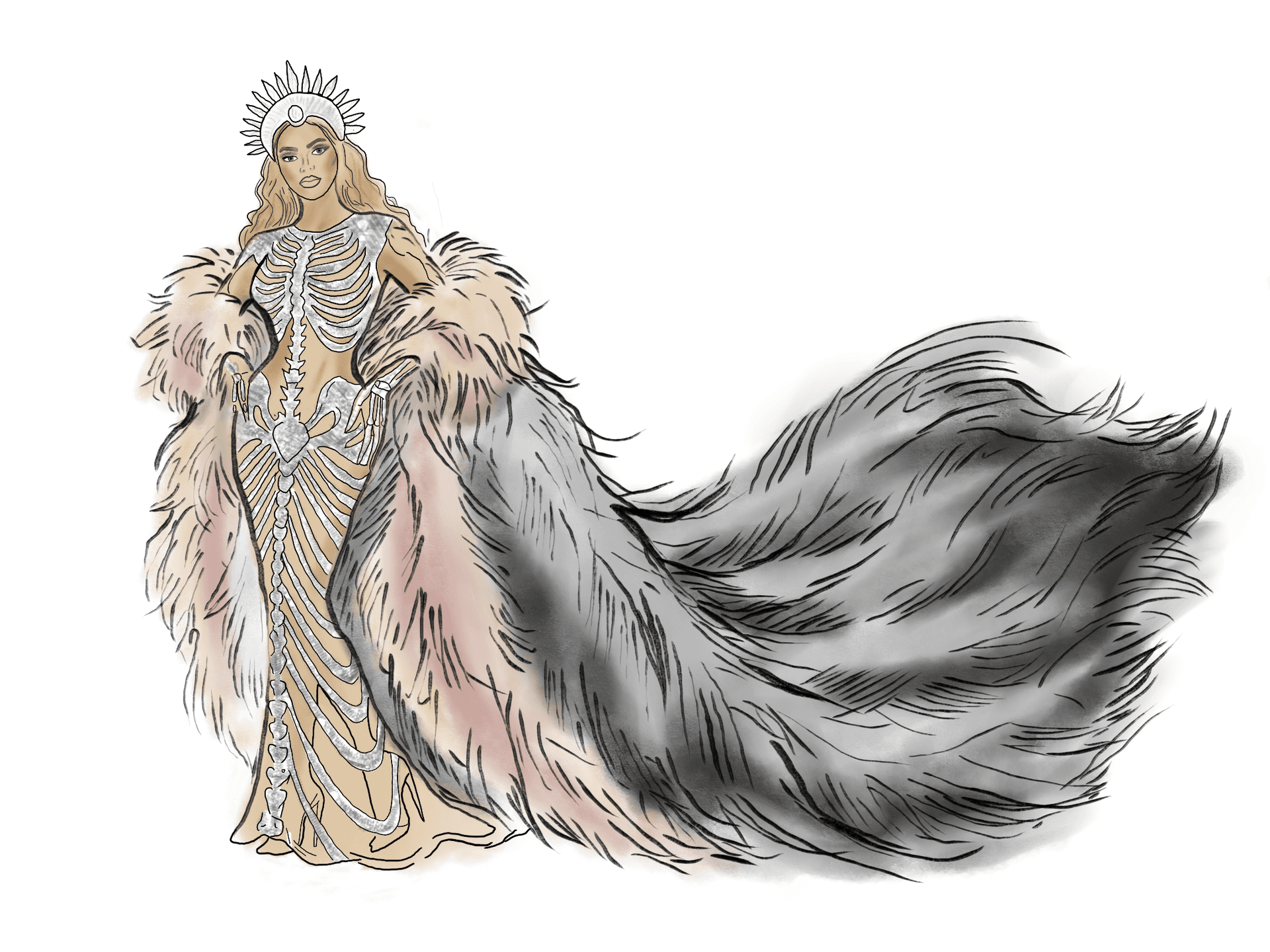
Where the painterly cluster dressed the body to resemble art, this section dressed the body as art. This was where the Costume Institute's curatorial framing—the Naked Body, the Classical Body, the Pregnant Body, the Aging Body—registered most directly on the carpet, and the night produced four extraordinary anatomical statements that, taken together, formed the most coherent visual response to Bolton's exhibit thesis the carpet could have offered. Beyoncé opened the night as co-chair in a custom Olivier Rousteing sheer crystal-mesh gown with anatomical skeletal beading tracing the spine and ribs, a pale ostrich-feather cape pooling into a long train, and a sunray crown: the Naked Body and the Classical Body fused at the neckline. Jeremy Pope answered with the men's counterpart in a high-neck long-sleeve top entirely beaded in tonal cream, gold, and amber pearls and crystals to form a trompe-l'œil sculpted male torso, every pectoral and abdominal muscle rendered in beadwork like a Renaissance écorché anatomy study. Kim Kardashian went hyperrealist with the same idea, arriving in a custom Allen Jones and Whitaker Malem sleeveless bronze-orange latex sculpted bodysuit rendered as an explicit anatomical specimen, with three-dimensional pectorals, abs, navel, and ribs molded into the latex itself. And model Adut Akech took the exhibit's "Pregnant Body" section as direct inspiration, arriving in a custom Thom Browne gown embroidered with over 1,000 handmade silk lily-of-the-valley blossoms—the May birth flower — that the designer told Vogue he made for "someone experiencing one of life's great miracles." It was the clearest articulation of the night's brief: a woman's pregnant body as the literal subject of fashion-as-art history.
Rihanna closed the carpet, as is tradition, in a custom Maison Margiela couture gown of champagne-and-silver crinkled liquid metallic, wrapped in an enormous architectural scroll cape, the high-necked torso entirely encrusted in jeweled crystalline beadwork like a byzantine icon's mantle, beaded crystal headpiece dripping pearls across her forehead. The look fused medieval architecture with metallic technology, Margiela's spring 2025 couture inspiration filtered through Rihanna's signature gravity-defying late entrance.
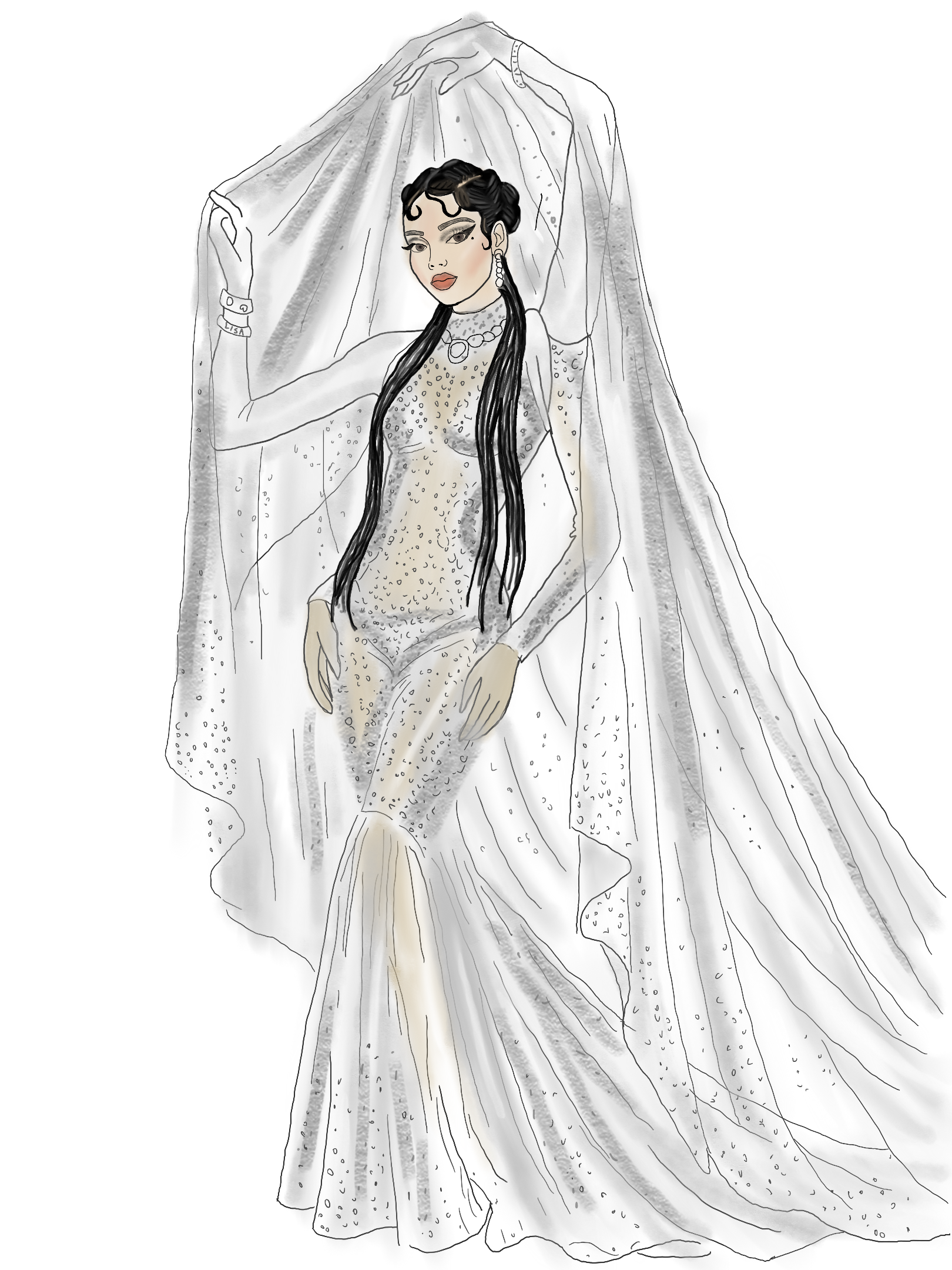
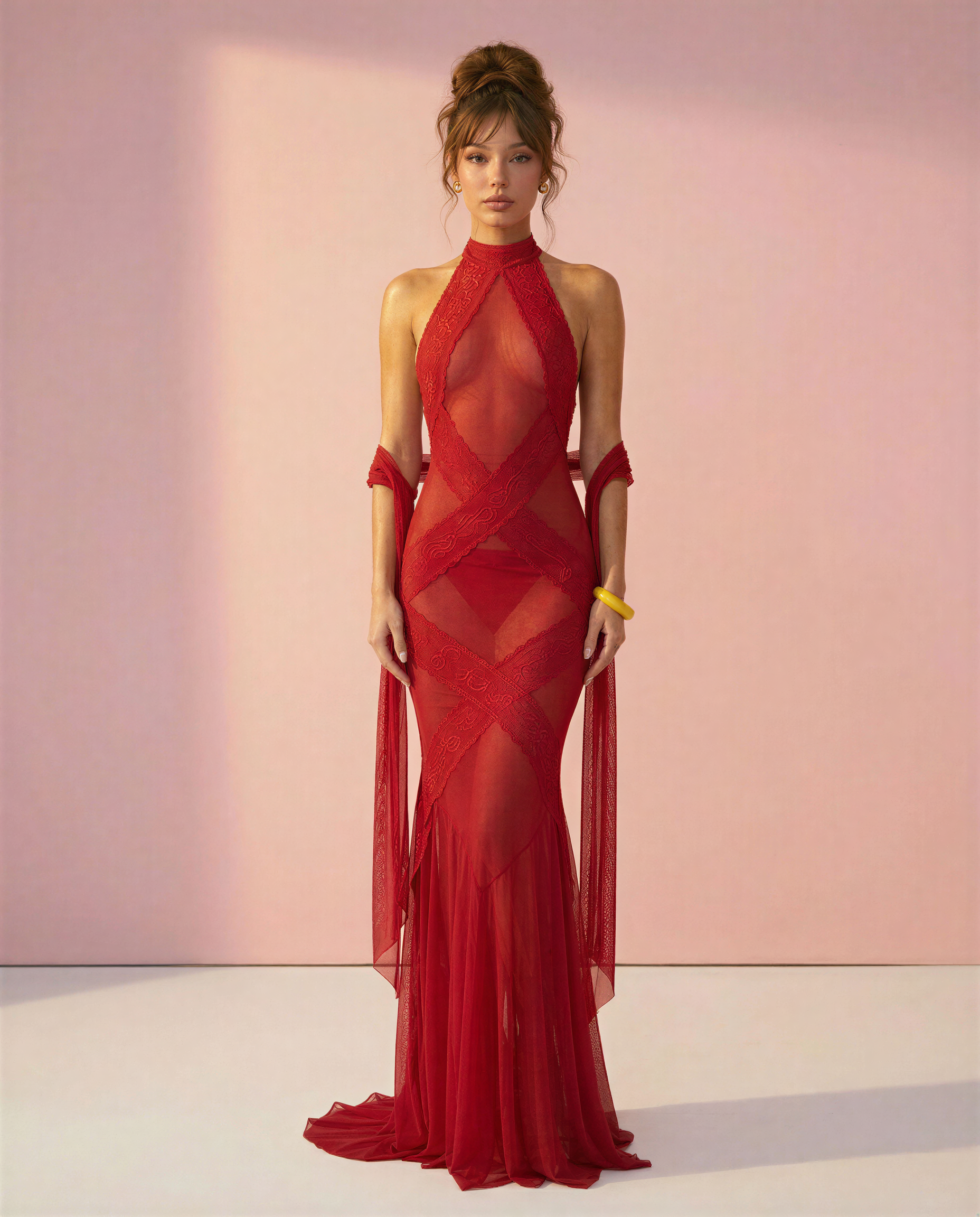
The sheer beauty trend, the single most-repeated aesthetic across the women's data, extended this body-forward idea. Cardi B went sculptural in a custom Marc Jacobs sheer black chantilly lace catsuit with shifting peach-to-lilac ombré underlay and enormous quilted floral bouquet puffs at the shoulders and feet, a look reportedly inspired by radical surrealist artist Hans Bellmer. Kate Moss, in her first Met Gala in over a decade, distilled the trend to its essence in a sheer black Chantilly lace gown with a tiny waist bow and burgundy chiffon scarf train. Lisa (pictured left) of BLACKPINK drifted up the steps in a custom Robert Wun high-neck mermaid gown encrusted entirely in micro-crystal beadwork with an enormous tulle bridal-style veil cascading from her crown, opera-length sheer-beaded gloves, and twin ponytail strands falling forward like ribbons. Donatella Versace wore a bias-cut nude column with a structured corset bodice in radiating crystal-beaded sunburst pattern, Sabrina Carpenter in Dior halter-tied strips of measuring tape and film negatives into a beaded-fringe Dada cocktail dress with a 1920s flapper headpiece, and Gigi Hadid took the sheer body to its most expressionist endpoint in a transparent black mesh Miu Miu gown with sculpted silver flame appliqués rising up the bodice like smoke.
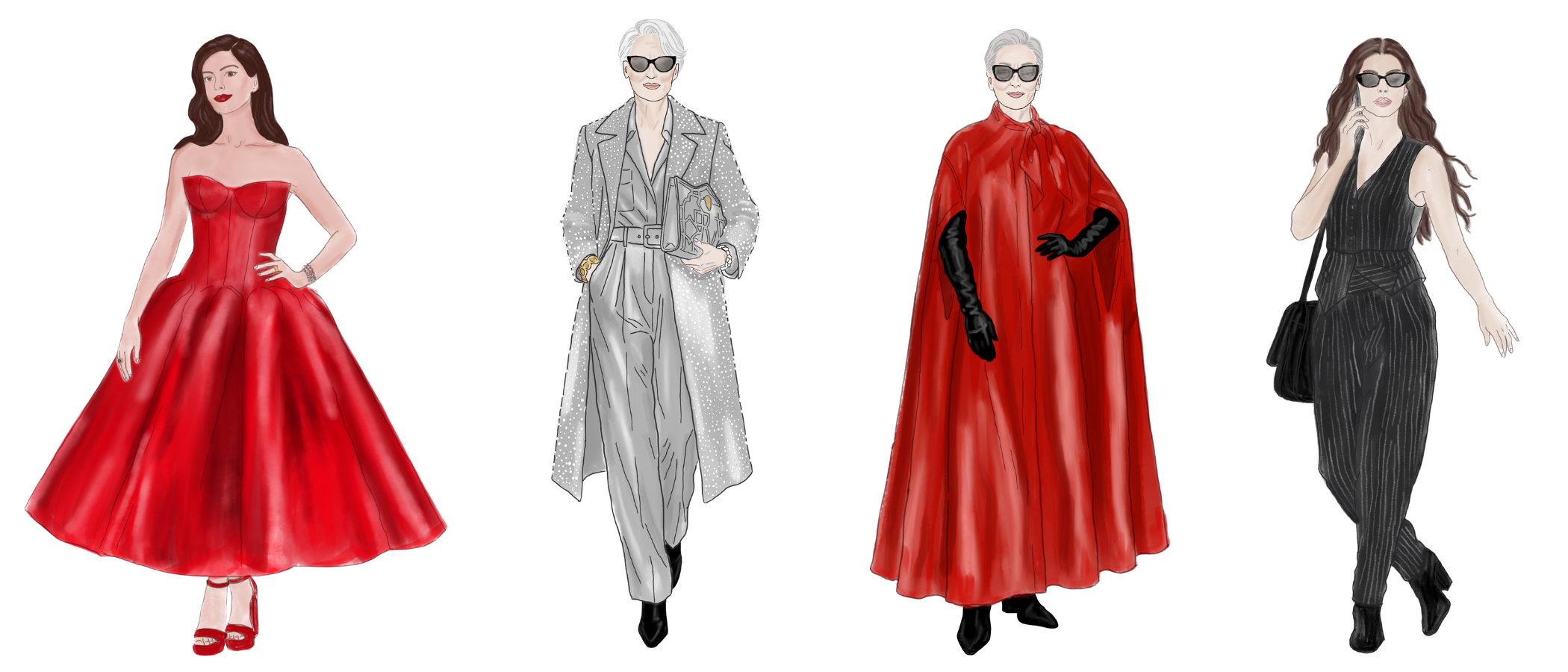
The night's most explicitly conceptual women's looks came from designers willing to treat the gown as a literal art object. Anne Hathaway wore a strapless black silk faille custom Michael Kors ballgown hand-painted by artist Peter McGough (Kors's former classmate) with white scrolling vine and laurel motifs tracing every seam, a trompe-l'oeil keyhole cutout outlined in painted scrollwork, and a portrait of Eirene, the ancient Greek goddess of peace, rendered across the back. Audrey Nuna wore a literal Pollock: a white floor-length coat splattered head-to-toe in black paint with structured shoulders, matching wide-brim splatter hat, and black lip. Tessa Thompson wore an ultra-saturated cobalt gown with sculptural curling 3D appliqué at the bust, all electric blues and a direct nod to artist Yves Klein's signature International Klein Blue, finished with a "puddle" hem of the same vivid pigment. Gwendoline Christie in Giles Deacon went canonical surrealism, holding a Magritte: a Venetian mask-shaped mirror with a tiny painted mouth, paired with a deep red satin mermaid and a feathered headpiece exploding in fuchsia, emerald, and cobalt plumes. NingNing in Gucci sculpted black tulle into a coral-reef organza-cone bouquet, Hoyeon rendered black leather around a 3D rose hip detail in fully sculptural form, and Madonna in Saint Laurent by Anthony Vaccarello arrived in head-to-toe black with a tall structural feather-and-chain headpiece, holding a circular gold horn. Dark cult party priestess in full vestment.
Modern haute couture filled in the rest. Wendi Murdoch, Alysa Liu in Louis Vuitton oxblood satin tiered ruffles, Nichapat, Karina of aespa in a Prada black opera-coat-over-white-gown silhouette, Jasmine Tookes in a beaded gold floral train, Julianne Moore, Misty Copeland in earth-toned ballet leather and tulle, and host committee co-chair Zoë Kravitz in floral lace Saint Laurent each read as wearable canvases: gowns built less to be worn than to be hung.
Suiting as Subject
The men's carpet historically struggles to keep up with the women's at the Met Gala (there are only so many things you can do with a tuxedo), but "Fashion Is Art" pushed this year's men past the standard penguin suit into genuinely conceptual territory. The night opened with one of the most theatrical character interpretations the carpet has ever produced. Bad Bunny, age 31, arrived as an aged Don Corleone—the only man on the carpet to take the Costume Institute's "Aging Body" curatorial section as literal direction. The black wool tuxedo (a custom Zara collaboration) was paired with Mike Marino's prosthetic work—the same artist behind Heidi Klum's marble transformation—full white hair and beard, hyperrealistic age makeup down to the hands, and a gold-tipped cane. The look was Italian mafia taken to its theatrical conclusion: fashion as embodied performance art. He set the tone for a men's section dominated by sharp tailoring with attitude. Jay-Z kept the don energy in a classic three-piece Louis Vuitton tailcoat tux with a silver brocade tie and white rose boutonnière. Maluma delivered restrained black-on-black in Tom Ford by Haider Ackermann with a sleeveless sequined vest, Romeo Beckham sharpened it further in double-breasted leather-lapeled tailoring, and Stanley Tucci, who appears in The Devil Wears Prada 2 (the long-awaited sequel with its own thoughts on the Wintour fashion universe), turned up in a forest-green velvet smoking jacket and grosgrain bow tie. Adrien Brody added an artistic twist in Dior with a silver feather brooch and a tan tulle train trailing from his black blazer, while Morgan Spector and Paul Anthony Kelly anchored the broader Sprezzatura cluster in Saint Laurent and Dior respectively.
The other dominant men's mood was karasu zoku, the Japanese all-black avant-tailoring whose name translates roughly to "crow tribe." Troye Sivan wore a long black wool overcoat with an enormous shearling shawl collar over vintage jeans, his white silk gloves the unexpected accent, while Bill Skarsgård layered a patent vinyl Thom Browne trench over a fully buttoned three-piece black suit, and Jimmy Butler delivered the night's most architectural men's silhouette in a deconstructed cropped sharp-shouldered black blazer over wide-leg pleated trousers. Joe Burrow worked the Antwerp Six dandy mood in a Bode navy smoking jacket with elaborate black soutache frog closures.
The most theatrically dressed men leaned into black dandyism, a continuation of last year's "Superfine: Tailoring Black Style" Costume Institute theme. Al Sharpton delivered the highest single-aesthetic match in our entire dataset in a gold-pinstripe-on-black double-breasted long-line coat with matching trousers, slim black tie, and white pocket square. Pure dandy, no notes. Dwyane Wade wore a sleeveless double-breasted tuxedo vest with peak satin lapels (full sleeve tattoos exposed), pleated wide-leg trousers, dark sunglasses, layered chains, and a gold daisy brooch: a quietly revolutionary update to black tie, echoed by Connor Storrie in a Saint Laurent sleeveless black halter-neck polka-dot top with high-waisted trousers and a small fabric train. Anderson .Paak wore a custom Amiri black blazer with all-over silver compass-rose embroidery and round dark sunglasses, Jeremy Pope doubled down with that anatomical bodysuit, and A$AP Rocky made the case for the modern Wes-Anderson-meets-Schiaparelli dandy in a full Chanel pink double-breasted long-line suit with black grosgrain piping, a black ostrich-feather brooch, and peach fringe trim. Babyface, Daniel Benedict, and Jeremy Pope rounded out the disco polo thread.
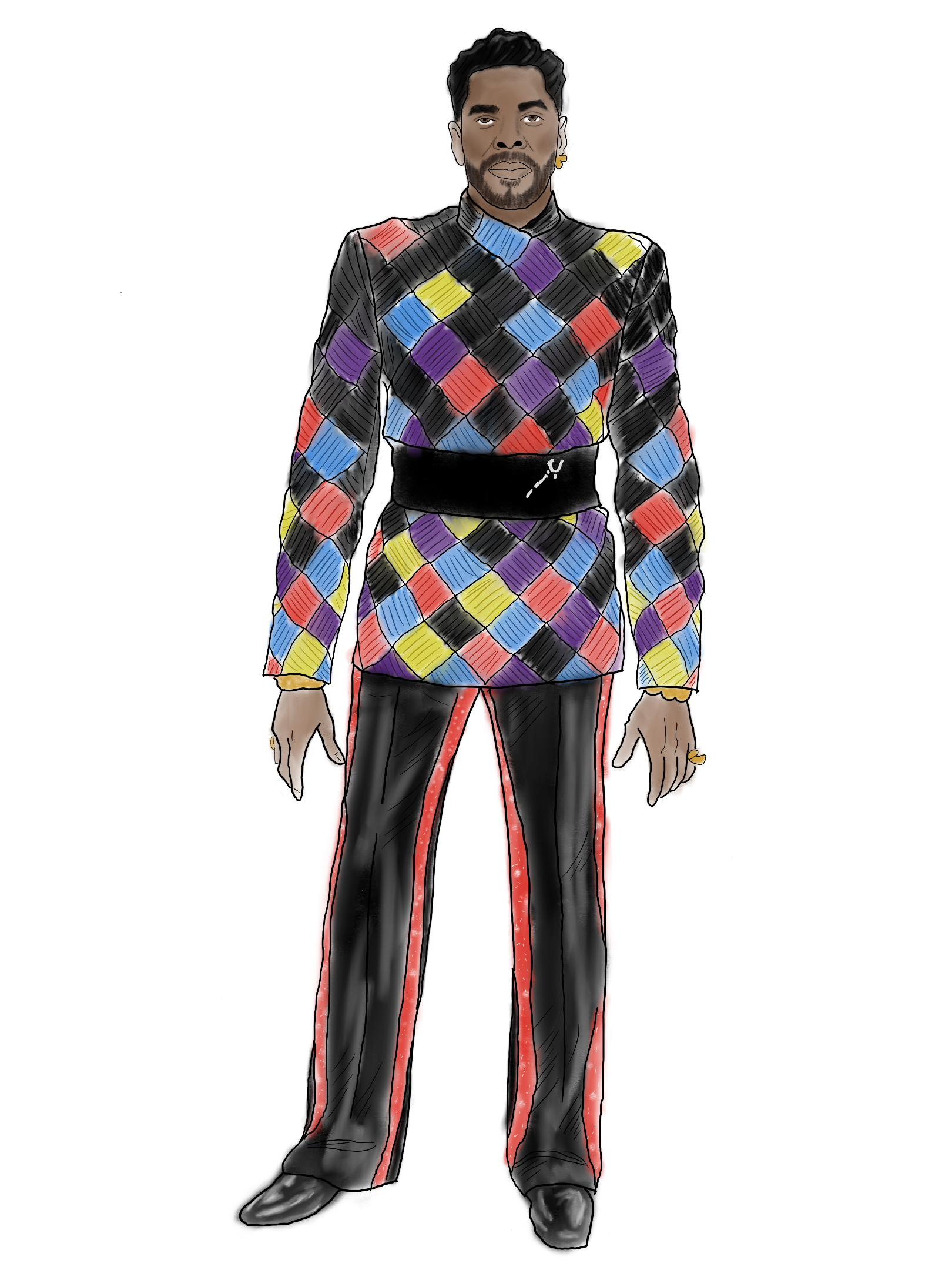
But the most theme-perfect men's looks were the ones that brought actual art movements onto the suit. Colman Domingo (pictured right) appeared in Valentino: a literal harlequin top, diamond pattern in red, yellow, royal blue, purple, and pale blue across a tunic, cinched at the waist with a black pleated obi belt, paired with black trousers with sparkling red side-stripes. A commedia dell'arte costume rendered as Bauhaus geometry. Cai Xukun's tailoring was split down the center between cream stitched-line embroidery and cascading red-and-silver beaded fringe, like a Pollock action painting frozen on a suit. And Hudson Williams went full traje de luces in Balenciaga by Pierpaolo Piccioli: a pale blue matador's suit-of-lights inspired by a 1947 bolero from house founder Cristóbal Balenciaga, complete with elaborate black soutache embroidery, a dramatic black satin capote sweeping behind him from the waist, and painted dark blue smoky eye for the full corrida effect. International standouts Ahn Hyo-seop in a sequined ivory-and-gold blazer with a tied red silk neck scarf, and Jaafar Jackson in a navy velvet blazer with gold passementerie piping and a chest crest—making his Met Gala debut—closed out a men's lineup that finally felt like it was on the same conceptual page as the women's.
If "Fashion Is Art" gave celebrities permission to dress like museum objects, plenty of them took it as a directive. The clearest trend isn't a single aesthetic but a methodological one: 2026 fashion is referencing more, conceptualizing more, and treating the gown or the suit as a vehicle for genuine artistic argument. Expect the painterly impressionism of Emma Chamberlain's Van Gogh moment to ripple into bridal and wedding-guest gowns this summer. Expect sheer beauty to continue dominating awards-season carpets. Expect men's tailoring to keep splintering past the standard tuxedo into karasu zoku, dandy, and conceptual territory. And expect the pregnant body, the aging body, and the diverse body to keep reasserting themselves as fashion subjects in their own right, the way Bolton's curatorial framing argued they always have been.
Curious which of these aesthetics matches your own style? Try Mavira's style analyzer to find out where your wardrobe lands and discover small brands aligned with your aesthetic.
Image analysis conducted using Mavira's style analyzer. Outfit references and designer credits sourced from Met Gala 2026 coverage by Vogue, WWD, The Hollywood Reporter, Fashionista, NPR, Marie Claire, and CNN. Images drawn by Aubrey Stevens.